Dolls
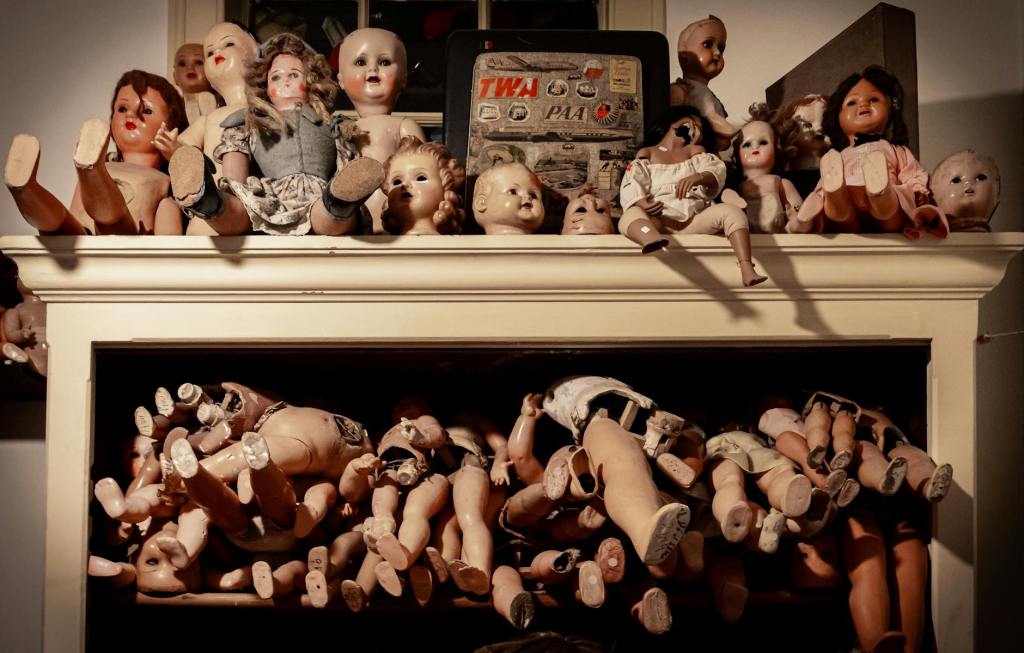
in popular culture haven’t done themselves any favours. They’re battling an
image problem. In the best case scenario, a discarded doll might end up on the
cover of a crime paperback, a drab emblem of sullied innocence; in the worst, as
in Chucky’s case, it will terrorise an entire town. To collect antique dolls,
as the protagonists of this novel do, is to be seen through a glacial mass of
cultural prejudice. What, we are inclined to wonder, does anyone see in them?
An
only child born with proportionate dwarfism, Andrew Garvie resigns himself at
an early age to exclusion and solitude, exchanging schoolyard taunts for dismal
office ‘banter’. ‘There is no point,’ he concludes, ‘in even trying to belong’.
He devotes himself instead to dolls, at first as an avid collector, then as
dollmaker in his own right. He haunts auction houses and scours even the
personal pages of specialist periodicals. It is here that he first encounters
Bramber Winters.
It
is here, too, that we enter the lives of dolls, but relax – it’s not what you
think. Nina Allan has been known until now for her speculative fiction, but The Dollmaker is not concerned with the
supernatural, at least in the usual sense. This literary experiment has a
conventional setting, in a contemporary England that feels only slightly askew.
The good news is that its living dolls are kept within safely figurative bounds,
avatars of the exotic in a moving fable of otherness. The bad news, at least
for some, is that they are every bit as unsettling as tradition requires.
Fittingly, given its subject, The Dollmaker toys with us almost from the start. It is framed by an oddball quest narrative, set in motion when Andrew replies to Bramber’s personal ad and the two begin a stilted but consuming correspondence. She is seeking information about a Polish writer and dollmaker named Ewa Chaplin, whose work has obsessed her since childhood. ‘She seemed to know,’ Bramber writes, ‘that dolls are people just like us.’
Andrew, it must be said, is a somewhat unreliable narrator, and at times resembles a peculiarly guileless stalker. ‘I had been writing to Bramber for a year,’ he says, ‘before I understood that we were destined to be together.’ This, we suspect, will come as a surprise to Bramber, whose own intentions are so far opaque. In her oddly ingenuous letters, she reminisces freely about her youth but is reticent about her present circumstances. Still, her hints are broad enough for the reader (suggesting an institional existence in a small Cornish village) if not for Andrew, who assumes that she simply dislikes using the telephone.
Fittingly, given its subject, The Dollmaker toys with us almost from the start.
Without
announcing his intentions, therefore, he resolves to visit her, embarking on the
bumbling odyssey that gives the novel its conventional momentum. Its
imaginative energy, though, unfolds unexpectedly from within, as if from a
series of opulent music boxes.
Andrew
sets out for the West Country, pursuing his romantic destiny with the stolid
meticulousness of a loveless scoutmaster. His reasonably priced rover ticket,
he notes with satisfaction, will enable him ‘to switch freely between bus,
coach and train’ as his itinerary demands. To pass the time on the journey, he
begins reading the Ewa Chaplin stories to which Bramber is devoted. And here
the mechanism quickens, setting its mirrors in motion.
The
stories are modern fairy tales, in the macabre and claustrophobic tradition of
Angela Carter, and are richly veined with myth and folklore. Their settings are
half-recognisable – a twilit Mittereuropa,
a London overshadowed by fascism – and their recurring motifs seem come to seem
foreboding. There is disfigurement and banishment, jealousy and thwarted
triumph. And there is a more persistent theme, familiar from the Schubert lied: the doomed love of a wilful queen
for her court dwarf. Here, as in the ballad, he is a figure not of ridicule but
of enigmatic potency, who destroys the queen because he cannot possess her.
Dolls are people, it seems, but perhaps not quite
like us.
Andrew
grows bolder as his encounter with Bramber approaches. When he steals a coveted
doll from a museum, he glimpses another self, a ‘dark and forbidden’ desire. Will
the dwarf destroy his beloved queen? Or are he and Bramber still free to choose
other fates? The Dollmaker purports
to be ‘a love story about becoming real’, and perhaps it is, in its sad and
mischievous way. But it is a story, too, about becoming unreal, about what we
choose to see, even in dolls, when we ourselves have gone for too long unseen. Who
will love us, after all, if not people just like us?
 vspr.st